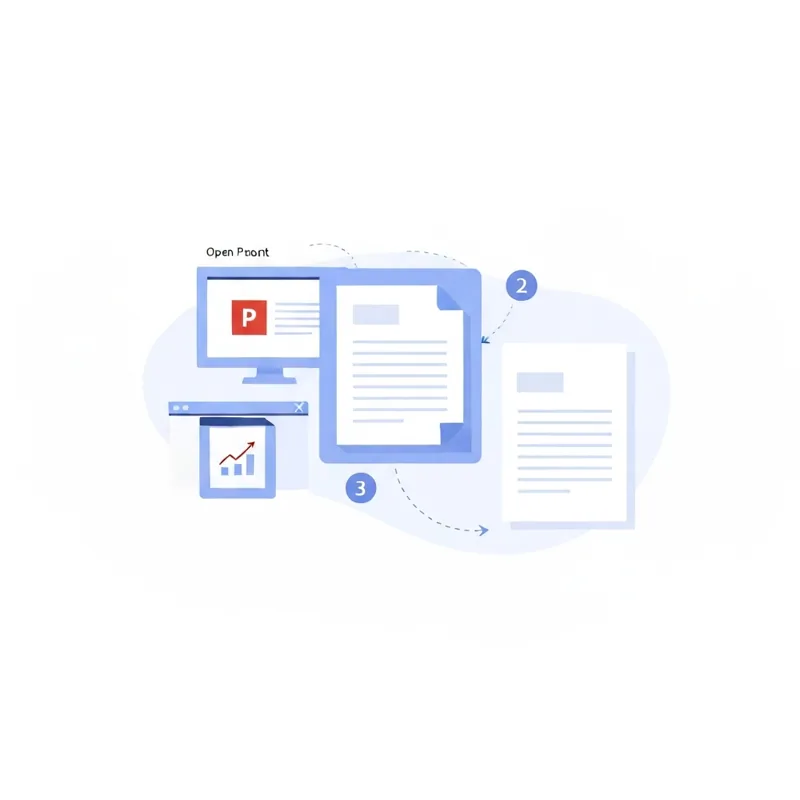
Turning a PowerPoint into a PDF locks your slides so they look the same on every screen. A free online converter does it in a few clicks.
- PDF keeps your fonts, colors, and layout fixed.
- Use PPT to PDF to convert in your browser.
- Anyone can open a PDF, even without PowerPoint.
- Follow a short checklist to get a clean result.
One file, fixed layout, opens anywhere - that is the PDF win.
Why a slide deck belongs in a PDF before you send it
A PowerPoint file is built for editing. That is great while you are still working on it, but it becomes a problem the moment you share it. Open the same deck on another computer and the fonts might shift. A photo might slide off the edge. A teammate could change a slide by accident. The reader may not even have PowerPoint installed.
A PDF solves all of that at once. It freezes your slides exactly as you made them. The layout stays put, the colors hold, and the file opens on a phone, a laptop, or a library computer without any special program. So before you hit send, it is wise to convert. Let us look at how to do it cleanly and what to check along the way. Starting from a blank page instead? The AI Presentation Maker researches your topic and builds a designed PDF slide deck for you.
The simple way to convert PPT to PDF
You do not need to buy anything or install software. A browser and your file are enough. Here is the path:
- Go to PPT to PDF.
- Upload your .ppt or .pptx file by dragging it in or clicking to select.
- Let the tool process the slides. This usually takes a few seconds.
- Download your finished PDF.
That is the whole process. The tool reads each slide and lays it out as one page in the PDF, in the same order you arranged them. If your deck has 20 slides, your PDF has 20 pages.
Your pre-conversion checklist
A clean PDF starts with a tidy deck. Run through this short checklist before you convert, and the result will look polished every time:
- Proofread your text. Fixing a typo is far easier in PowerPoint than in the PDF.
- Check your slide order. The PDF keeps whatever order your slides are in.
- Look at images near the edges. Make sure nothing important is cut off.
- Use common fonts. Standard fonts travel safely into the PDF.
- Remove empty or extra slides. A leaner deck makes a leaner file.
- Save your latest version. Convert the final draft, not an old copy.
Tick each box and you avoid the most common surprises. A minute of checking saves you from re-doing the whole thing later.
What changes and what stays the same
It helps to know what to expect once your slides become a PDF. This quick table lays it out:
| Feature | In PowerPoint | In the PDF |
|---|---|---|
| Layout and colors | Can shift on other devices | Stays fixed everywhere |
| Editing slides | Easy to change | Locked in place |
| Animations | Play on click | Show as a still slide |
| Who can open it | Needs PowerPoint | Opens on almost any device |
| File size | Often large | Usually smaller |
The big trade is simple. You give up animations and easy editing, and you gain a file that looks right for everyone. For most sharing, that is exactly what you want.
Handy follow-up tools after you convert
Once your deck is a PDF, a few more tools can help you finish the job. If the file is large, run it through Compress PDF so it emails fast. Need to combine your slides with a cover letter or report? Merge PDF joins them into one file. Want only a few slides from the deck? Split PDF pulls out just the pages you need. And if you later want the slides back as an editable deck, PDF to PPT reverses the process. For more background, the guide on turning a PowerPoint into a PDF and the post on compressing PPT presentations are worth a read.
Turning your PowerPoint into a PDF the right way
Converting a slide deck is one of the easiest wins in document work. You upload to PPT to PDF, you wait a few seconds, and you walk away with a file that looks the same for everyone who opens it. Run the checklist first, glance at the table so you know what changes, and lean on the follow-up tools when you need them. Do that, and turning a PowerPoint into a PDF becomes a calm, quick habit you can trust every single time you share your slides.
Compare PDF tools
 Continue with Google