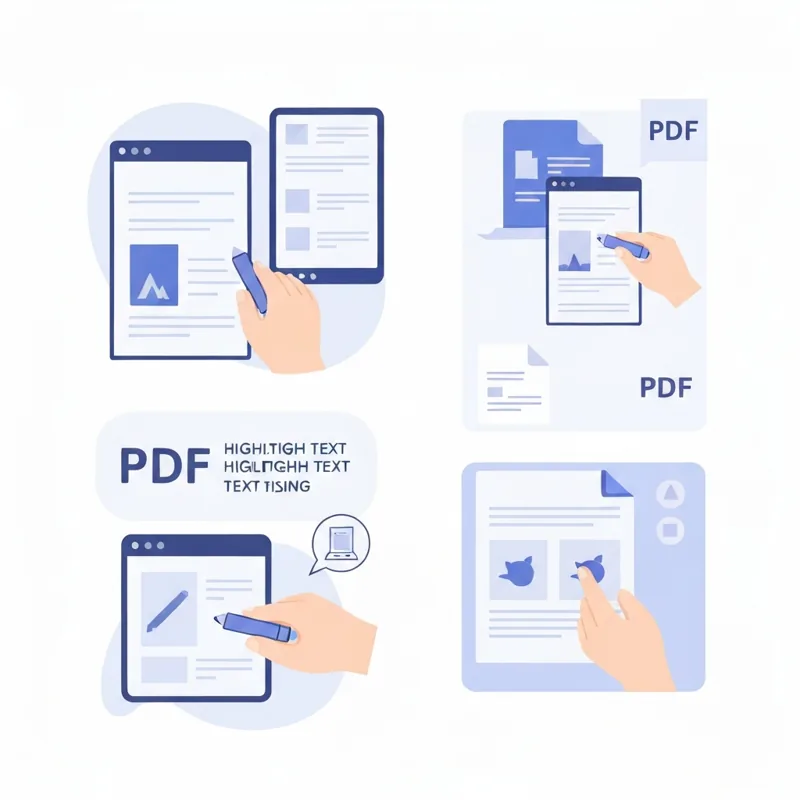
Long PDFs hide the important bits in a wall of text. Highlighting paints the key lines in color so they jump out the moment you reopen the file.
- Highlighting marks the lines that matter most.
- It works right in your browser, no app needed.
- Your highlights save inside the PDF and travel with it.
- Reviewers and study buddies see the same marks you do.
A swipe of color turns a messy PDF into a map of what matters.
The wall of text that swallows the point
You open a long PDF, a contract, a report, or a chapter, and the important sentence is buried somewhere in the middle. You read it, you nod, you close the file. A week later you open it again and that key line has vanished into the gray blur of every other paragraph. Now you are scrolling and squinting, hunting for the one part that actually mattered. That hunt repeats every time, and it is a quiet daily waste of your attention.
The pain is not the reading. It is the re-finding. Plain PDF text gives your eyes nothing to grab onto, so the brain treats every line as equally loud. What you need is a way to make a few lines loud and let the rest fade into the background.
The fix: paint the important lines in color
Highlighting solves the re-finding problem in one move. You drag across a sentence, it fills with color, and from then on your eyes land on it instantly. The Edit PDF tool lets you do this online without installing anything. Upload your file, pick the highlighter, and swipe across the words you want to mark. The color saves inside the document, so when you or anyone else reopens it, the marks are still there.
It works because of how human eyes scan a page. Color breaks the pattern. A yellow band on a white page is the first thing you see, before you even start reading. So instead of rereading the whole document to find your point, you skim for the color and stop. That is the whole reason highlighting feels so much faster than plain reading.
Here is what you actually gain once your key lines are marked:
- Faster review. Reopen the file and your eyes go straight to the colored parts.
- Shared clarity. Send it to a teammate and they see the same marks, so you are both looking at the same lines.
- Better studying. Mark definitions and dates, then skim only the color before a test or a meeting.
- Cleaner feedback. Point out the exact wording you want changed without typing a long note.
- Memory help. The act of choosing what to highlight makes you decide what is truly important.
Make your highlights work even harder
Once you are comfortable with the highlighter, a few extra steps make your marked-up PDFs far more useful. If a single document is huge, run it through Split PDF first so you only highlight the section you care about. If you are pulling together pages from several files, Merge PDF combines them into one document, and then your highlights live in a single tidy place.
Want to do more than color? The same editor lets you add notes and shapes, which pairs well with our guide on how to write on a PDF when a highlight alone does not say enough. And if your file is a scan rather than typed text, our piece on what optical character recognition is and how to use it explains how to turn that scan into selectable words you can actually highlight.
Highlight text in a PDF and never lose the point again
The goal was never to make the page pretty. It was to stop losing the important line in a sea of text. Highlighting text in a PDF gives you a permanent, shareable marker that says "this part right here." Open the Edit PDF tool, swipe across the words that matter, save, and the next time you open that file the answer is waiting in color instead of hiding. Less scrolling, less squinting, and a lot less time wasted re-finding what you already read.
Compare PDF tools
 Continue with Google